
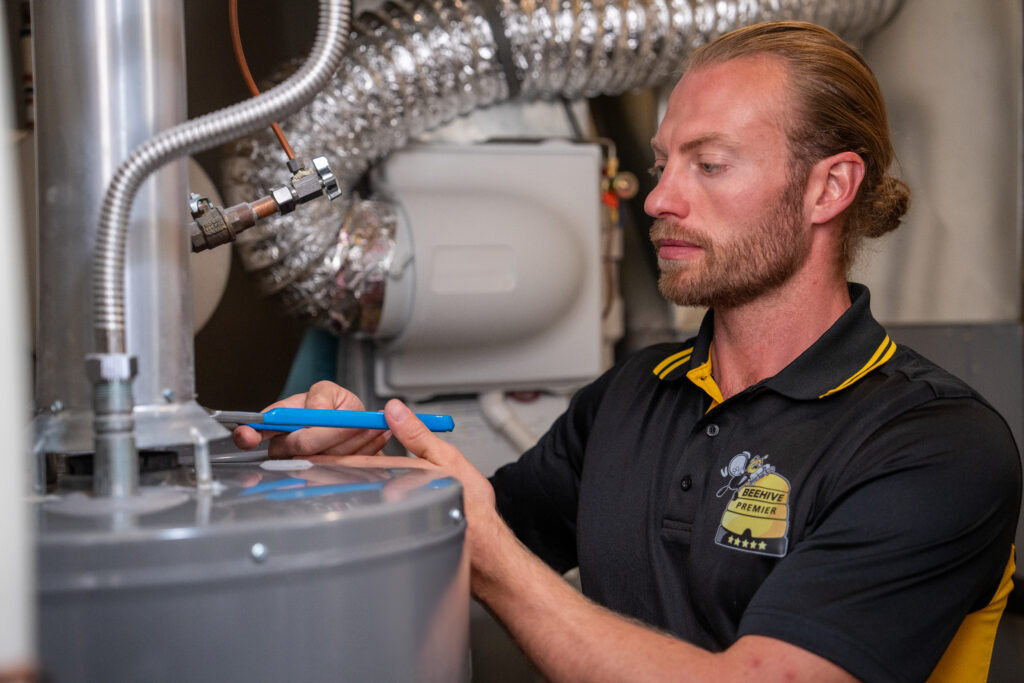
A water heater rarely fails at a convenient time. In Park City, freezing winters and mineral sediment can make a sudden loss of hot water even more disruptive.
Making the wrong choice could mean spending money on repairs that only delay the inevitable or replacing a system that still has useful life left.
A practical decision starts with the unit’s age, the source of the problem, the repair estimate, and the condition of the tank and its components.
No single factor settles the question. A newer unit with one replaceable part may be worth repairing, while an older tank with corrosion or repeated failures may be a poor candidate for more work.
At Beehive Plumbing, we’ve served Utah homeowners since 1999. This guide explains when a repair may be reasonable, when replacement deserves serious consideration, and what Park City homeowners should verify before deciding.
Key Takeaways
- Repairing makes sense when the problem is isolated, the unit is relatively new, and you’re dealing with minor issues.
- A common budgeting guideline is to compare the repair estimate with the installed cost of a comparable replacement, but the percentage alone should not decide the job.
- Age, maintenance history, tank condition, and recent breakdowns matter as much as the repair price.
- Mineral sediment can reduce performance, cut available hot-water capacity, and add strain, although actual water hardness varies by property and water source.
- Choosing the right replacement depends on several factors, including your home’s budget, energy goals, and hot-water demand.
- A replacement must follow current manufacturer instructions and applicable permit, venting, seismic-restraint, drainage, and inspection requirements.
- A licensed plumber can identify the failed component, inspect the tank, and compare repair and replacement options before work begins.
How to Know if Your Water Heater Should Be Repaired or Replaced
Not every water heater problem calls for replacement. Start with two questions: Is the failure isolated, and does the rest of the system remain in serviceable condition?
Use the 50% Guideline as a Starting Point
The 50% guideline is a planning tool, not a code or universal industry rule. When a repair approaches half the installed cost of a comparable new unit, replacement deserves a closer financial review.
The guideline becomes more useful when it is considered with age, warranty status, tank condition, and repair history. An expensive repair does not reset an older water heater to new condition.
Use the guideline in three steps:
- Get a written repair estimate before making a decision.
- Compare that cost with the installed price of a similar replacement unit.
- If the repair approaches or exceeds 50% of the installed replacement cost, compare the remaining service life and warranty coverage before approving the work.
A failed heating element, thermocouple, malfunctioning thermostat, ignition component, or other serviceable part may justify repair when the tank is sound, and many of these are straightforward water heater installation and repair services issues that may be inexpensive to fix if the tank itself is still in good shape and the unit has not developed a pattern of failures.
Avoid making the decision from a headline price alone. Repair is usually most cost effective when the current unit is still sound and the work does not point toward a full replacement. Compare written scopes that show what the repair includes, what a replacement requires, and which warranties apply to both options.
How Your Water Heater’s Age Affects the Decision
Repair cost is important, but it should always be considered alongside your water heater’s age. Most traditional tank water heaters last between 8 and 12 years, and manufacturer guidance generally treats the 10-year mark as the point where replacement becomes a more practical option.
Once a unit reaches 10 to 12 years old, even a relatively minor repair deserves a closer look. Older water heaters often experience wear across multiple components, so fixing one issue today may simply delay another repair a few months later.
Frequent repairs are another warning sign. If your water heater has needed several repairs within a short period, constant repairs usually mean replacement is the smarter investment because the unit is nearing the end of its reliable service life.
Utah’s climate, incoming-water temperature, and mineral conditions can influence a water heater’s lifespan. Still, the condition of the specific unit matters more than a statewide average.
Repair often makes sense for a newer unit with an isolated, serviceable problem. Replacement becomes more compelling when age, tank deterioration, recurring failures, and constant repairs point in the same direction.
How to Tell Something Is Wrong with Your Water Heater
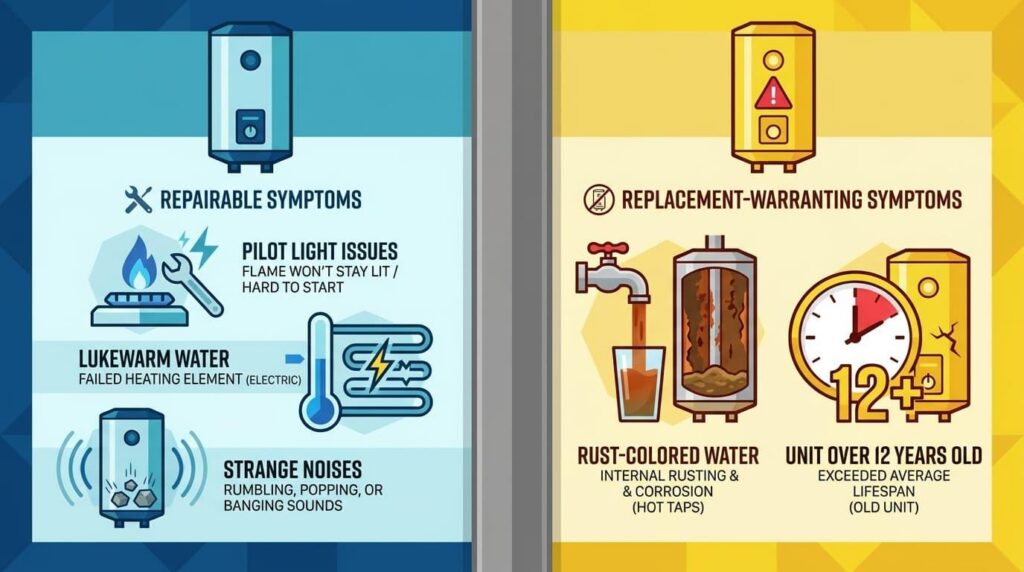
Some water heater problems are minor, while others indicate a failing system. Recognizing the difference can save you time, money, and unnecessary repairs.
Signs Your Water Heater Can Likely Be Repaired
These issues often point to a single faulty component rather than a failing water heater:
- Pilot light issues on a gas water heater often point to a repairable component rather than a failing tank.
- Tripped circuit breaker on an electric unit.
- Lukewarm water caused by a failed heating element.
- Faulty thermocouple preventing the burner from staying lit.
- Pressure relief valve releasing intermittently because minor leaks may come from fittings or valves rather than internal tank corrosion.
Catching issues early can turn small faults into simpler repairs. Changes in water color, temperature, pressure, or sound can help homeowners spot plumbing problems early. A licensed plumber should still inspect the system before identifying the cause.
Signs It’s Time to Replace Your Water Heater
Some problems point to a water heater that’s nearing the end of its service life, making replacement the more practical long-term solution. These include:
- Rust-coloured water from hot taps, which may indicate internal tank corrosion.
- A persistent leak coming from the tank itself rather than a fitting or valve, which usually means the entire unit has failed.
- Strange noises such as rumbling or banging, which often signal heavy sediment buildup inside the tank.
- A unit that’s more than 12 years old, especially in Park City where hard water speeds up mineral accumulation.
- A pressure relief valve that discharges repeatedly, or corrosion and a tank-wall leak, which generally means tank replacement is necessary.
Park City’s hard water can shorten the lifespan of a water heater by allowing sediment to build up faster inside the tank. During winter, cold-weather water heater failures can place even more strain on an already aging system, increasing the likelihood of a complete breakdown.
Water Heater Options When It’s Time to Replace
A new water heater is a long-term investment, so choosing the right type matters. Tank, tankless, and heat pump models each offer different benefits depending on your home’s needs and budget.
The table below offers a quick snapshot before diving into each option in detail.
| Feature | Tank | Tankless | Heat Pump |
| Upfront Cost | Lower | Higher | Highest |
| Lifespan | 8–12 years | Up to 20 years | 10–15 years |
| Energy Efficiency | Standard | High | Very High (UEF 2.75–3.5) |
| Altitude Sizing Needed | No | Yes | No |
| Federal Tax Credit Eligible | No | Possibly | Yes |
Standard Tank Water Heaters
Storage tank water heaters remain a familiar replacement option for many Park City homes. Available capacities vary, so the right size depends on household demand, including patterns like back-to-back showers and laundry loads, recovery rate, available space, and the home’s gas or electrical service.
Gas and electric storage models have different venting, electrical, operating-cost, and installation needs. A like-for-like replacement may be simpler, but it is still worth checking whether the existing size and fuel choice suit the home, especially if the current unit no longer keeps up with demand.
Homes that already use electric equipment must still compare recovery rate, installation needs, and operating costs. Weighing the pros and cons of electric water heaters helps homeowners judge whether that fuel type fits their hot-water demand.
Tankless Water Heaters
Tankless water heaters heat water only when you need it, eliminating the standby energy loss associated with traditional storage tanks. With proper maintenance, they can last up to 20 years while delivering excellent energy efficiency.
In Park City, proper sizing is especially important. Gas-powered tankless units must be selected with the area’s high elevation in mind, as thinner air affects combustion performance. A correctly sized system helps ensure consistent hot water throughout the year.
Although tankless systems cost more upfront, modern high-efficiency models can lower monthly utility bills and energy bills compared with older storage tanks, creating long term savings. That can make replacement worthwhile for homeowners who want a more efficient system and better overall efficiency over time.
Heat Pump Water Heaters
Heat pump water heaters are the most energy-efficient option available. Instead of generating heat directly, they capture heat from the surrounding air and transfer it to the water, allowing them to use far less electricity than conventional electric models.
Their lower operating costs can add up over time, and many models may also qualify for available federal energy efficiency incentives, helping offset the higher upfront investment.
With energy efficiency standards continuing to evolve, choosing a high-efficiency system can be a smart long-term investment. The latest federal water heater efficiency standards provide more detail on these changes and what they could mean for future water heater replacements.
Park City Code Requirements Every Homeowner Should Know
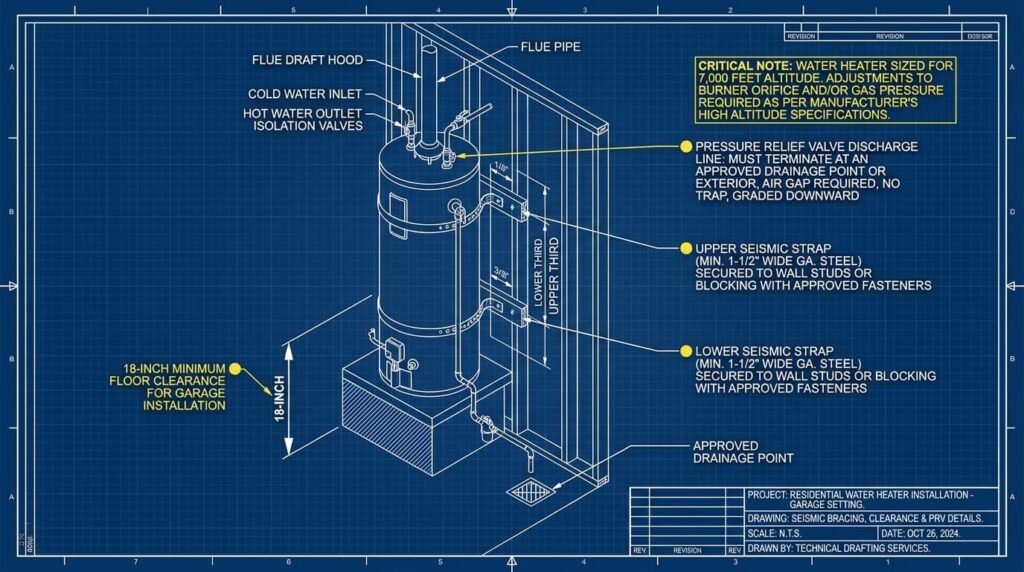
Installing a new water heater in Park City involves more than choosing the right unit. Local building codes include specific requirements that help ensure the system operates safely and passes inspection.
Altitude De-Rating for Park City
Park City’s elevation affects more than the weather. At roughly 7,000 feet above sea level, gas water heaters must be properly sized to account for thinner air, which reduces combustion efficiency.
A unit that’s correctly sized at sea level may not produce the same heating performance at higher elevations. That’s why altitude-adjusted BTU sizing is an important part of a proper installation.
Venting at 7,000 Feet
Venting requirements are equally important. The venting system must be designed to safely remove combustion gases while maintaining proper airflow for efficient operation. Incorrect vent sizing can affect performance and, in some cases, create carbon monoxide hazards.
These requirements are part of local building code and are verified during the permitting and inspection process, making proper installation essential for both safety and long-term performance.
Seismic Anchoring, Garage Installation, and Other Code Requirements
Every water heater installation in Park City must meet local building and safety codes. Some of the most important requirements include:
- Dual seismic straps secured to wall studs or blocking at the upper and lower thirds of the tank. A single strap does not meet code.
- Garage installations must position the water heater at least 18 inches above the floor to reduce the risk of igniting flammable vapors.
- Pressure relief valve discharge lines must terminate at an approved drainage point rather than inside the enclosure or directly onto the floor.
Permits and inspections are required for water heater replacements to verify the installation meets current code requirements.
Working with a licensed contractor helps ensure each of these requirements is addressed correctly. Attempting a replacement without the required permits or code knowledge can result in failed inspections, safety concerns, and many of the common DIY water heater mistakes homeowners later pay to correct.
At Beehive Plumbing, we handle every step of the installation process, from permits and code compliance to the final inspection. Our licensed plumbers make sure your new water heater is installed safely and correctly the first time.
Schedule Your Water Heater Service
What Park City Hard Water Does to Your Water Heater
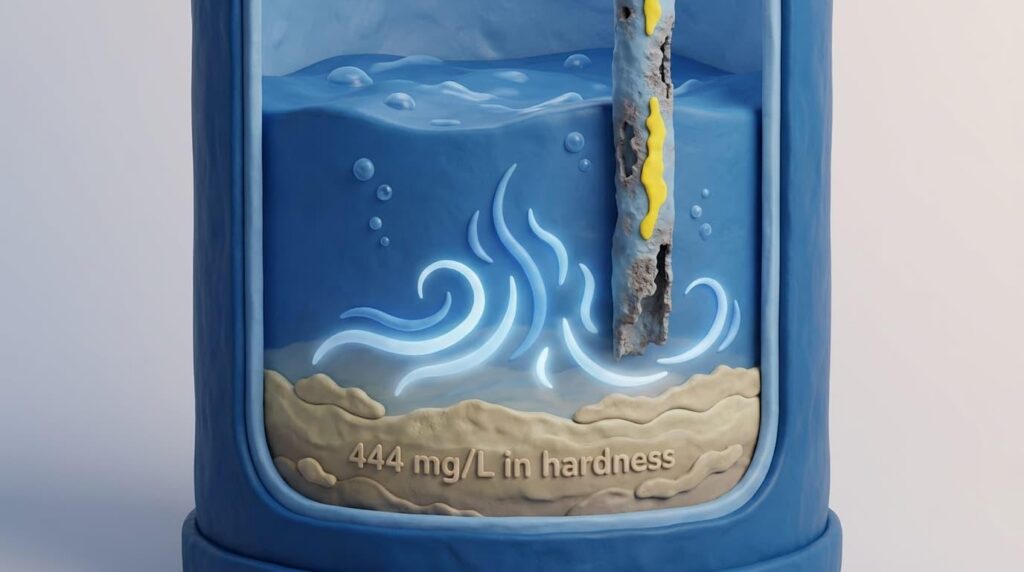
Park City’s water supply averages 444 mg/L in hardness, which classifies it as very hard, with high levels of calcium and magnesium. As your water heater operates, these minerals settle at the bottom of the tank, gradually forming a layer of sediment.
That sediment forces the heating system to work harder because heat has to pass through the mineral buildup before reaching the water. Over time, this reduces efficiency, cuts into the tank’s effective capacity as minerals take up space and insulate the water from the heat source, increases energy use, and puts additional strain on internal components.
According to residential energy consumption data, water heating accounts for a significant share of household energy use, so even small efficiency losses can affect your utility bills.
Popping or rumbling noises are often a sign that sediment has already accumulated inside the tank and that it should be flushed.
Hard water also causes the sacrificial anode rod to wear out more quickly, leaving the tank more vulnerable to corrosion. Regular flushing and water heater maintenance help reduce sediment buildup, extend the life of your system, and replacing that rod every 3 to 5 years can help you avoid costly repairs or premature replacement.
What to Expect During a Professional Water Heater Service Call

If you’ve never scheduled water heater service before, it’s helpful to know what the process looks like. A professional inspection is designed to identify the problem first, then recommend the most practical solution based on your unit’s condition.
A licensed plumber will assess your water heater by checking its age, overall condition, visible signs of wear, and key components such as the heating elements, anode rod, thermostat, and pressure relief valve. If a repair is possible, you’ll be told exactly what’s needed. If replacement makes more sense, you’ll receive clear recommendations based on the unit’s condition rather than guesswork.
If you’re dealing with a leaking tank, no hot water, or the smell of gas, don’t wait. These situations often require immediate attention and are typically prioritized for same-day service whenever possible.
Before any work begins, you’ll receive a clear, upfront quote so you know exactly what to expect.
A typical service visit includes:
- A complete inspection of the water heater and its major components.
- Diagnosis of the underlying problem and recommended repair or replacement.
- A clear, upfront estimate before any work begins.
- Permit handling and code compliance for replacement installations.
- Priority scheduling for urgent issues such as leaks, gas smells, or complete hot water loss.
Get the Right Solution for Your Park City Home
Choosing between repairing and replacing a water heater isn’t always straightforward. Factors like your unit’s age, repair costs, Park City’s hard water, and local installation requirements all play an important role in making the right decision.
At Beehive Plumbing, we take the time to assess your water heater before recommending the most practical solution. Whether a repair or replacement makes more sense, you’ll receive honest advice, quality workmanship, and a solution that’s built to last.
Schedule Your Water Heater Assessment
Frequently Asked Questions
Here are quick answers to common questions about repairing or replacing a water heater.
How Much Does It Typically Cost to Repair a Water Heater?
Most water heater repairs typically cost between $150 and $600, depending on the issue. Smaller repairs, such as replacing a heating element or thermocouple, cost less, while gas valve or pressure relief valve repairs are usually more expensive.
Is It Better to Repair or Replace a Water Heater?
It depends on the unit’s age and the repair cost. If repairs exceed about 50% of the replacement cost or the water heater is more than 10 to 12 years old, replacement is usually the better long-term investment.
How Much Does Water Heater Replacement Cost in Utah?
Most water heater replacements in Utah range from $900 to $2,500 or more, depending on the type of unit installed. Tankless and heat pump models generally cost more upfront but can provide greater long-term efficiency and lifespan.
What Is the Most Common Water Heater Problem?
Sediment buildup is one of the most common water heater problems, especially in Park City where hard water is common. Over time, mineral deposits reduce efficiency, increase energy use, and place additional strain on the heating system.
What Are the Signs a Water Heater Is Going Bad?
Common warning signs include rusty hot water, leaks from the tank, rumbling noises, inconsistent hot water, and repeated pressure relief valve discharge. If your unit is also over 12 years old, replacement may be the most practical option.
Can Hard Water Shorten the Life of a Water Heater?
Yes. Hard water causes mineral deposits to build up inside the tank, reducing heating efficiency and increasing wear on internal components. Regular maintenance and flushing can help minimize sediment buildup and extend your water heater’s lifespan.