
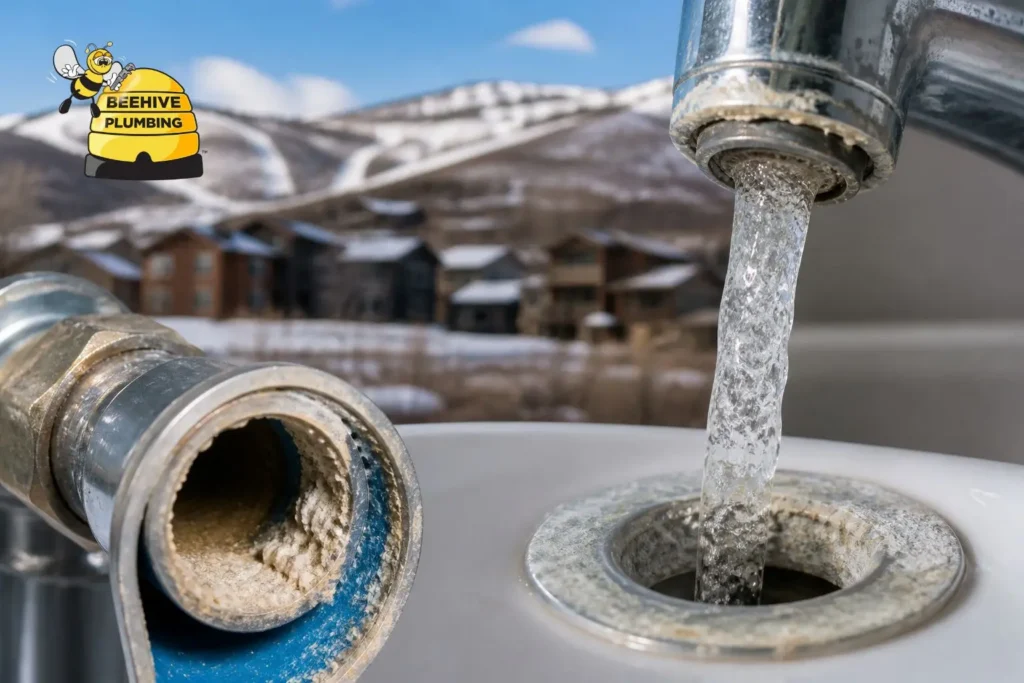
Hard water is common in Park City, Utah, and many homes have water hardness in the 15 to 25 grains-per-gallon range, which falls into the very hard category. For Park City homeowners, that high mineral content often shows up as white spots on glassware, chalky residue on fixtures, and appliances that seem to wear out sooner than expected.
Those signs may look minor at first, but they usually point to scale building up inside plumbing, water heaters, and other household systems, where hard water can reduce efficiency, shorten appliance life, and add to repair costs. If you’re trying to understand how Park City’s local geology affects your water, what hard water means for your pipes, laundry, skin, and hair, and whether solutions like water softeners for Utah homes or reverse osmosis make sense for your home, this article walks through each of those issues clearly.
In this article, we’ll explain why Park City’s water is so hard, how it impacts your plumbing and appliances, how hardness is measured, and the most effective ways to manage it.
Key Takeaways
- Water hardness varies across the greater Park City area; Mountain Regional Water reports a typical range of 15 to 25 GPG.
- Mineral scale can affect plumbing fixtures, water heaters, and water-using appliances over time.
- Hardness itself isn’t treated as a drinking-water contaminant, but homeowners should review their utility’s current water-quality report.
- Whole-home water softeners address calcium and magnesium throughout the home, while reverse osmosis primarily treats water at one tap.
- Testing the water at your home helps determine the appropriate treatment type, capacity, and settings.
How Hard Is Park City’s Water?
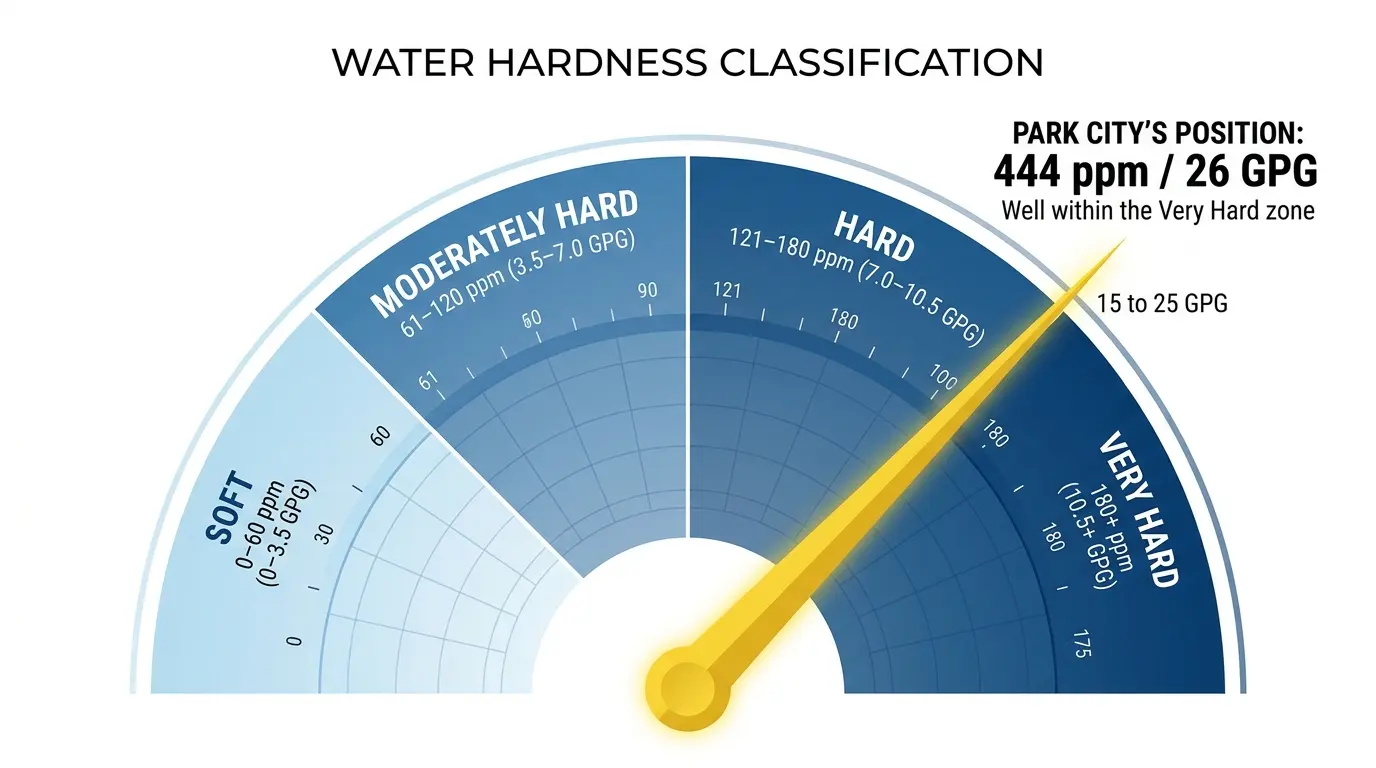
Water hardness varies across the greater Park City area because homes may receive water from different sources and providers, and that local variation sits within broader utah water hardness trends: the state averages about 298 PPM, while Park City is often cited around 444 ppm, or 26 grains per gallon. Mountain Regional Water’s 2025 Consumer Confidence Report lists a typical hardness range of 15 to 25 grains per gallon, or an average of approximately 300 mg/L as calcium carbonate. Under the U.S. Geological Survey classification, those water hardness levels place much of the area in the very hard category, since water above 180 mg/L is considered very hard.
[Image: USGS water hardness scale showing classification levels from soft to very hard, with Park City’s average of 444 mg/L marked in the very hard range]
How Hard Water Is Measured
Water hardness is commonly reported in grains per gallon (GPG) or milligrams per liter (mg/L), often expressed as calcium carbonate. These measurements reflect the concentration of dissolved hardness minerals, primarily calcium and magnesium.
The table below shows the USGS water hardness classification scale:
| Classification | mg/L (PPM) | GPG |
| Soft | 0–60 | 0–3.5 |
| Moderately Hard | 61–120 | 3.5–7.0 |
| Hard | 121–180 | 7.0–10.5 |
| Very Hard | 180+ | 10.5+ |
How Water Hardness Can Vary Across Park City
Regional figures provide a useful benchmark, but the hardness at an individual home may differ by utility, source, and distribution zone, and Park City publishes neighborhood-specific water quality information for park city residents. Check your provider’s current water-quality report or test the water at your tap before selecting treatment equipment.
Why Is Park City’s Water So Hard?
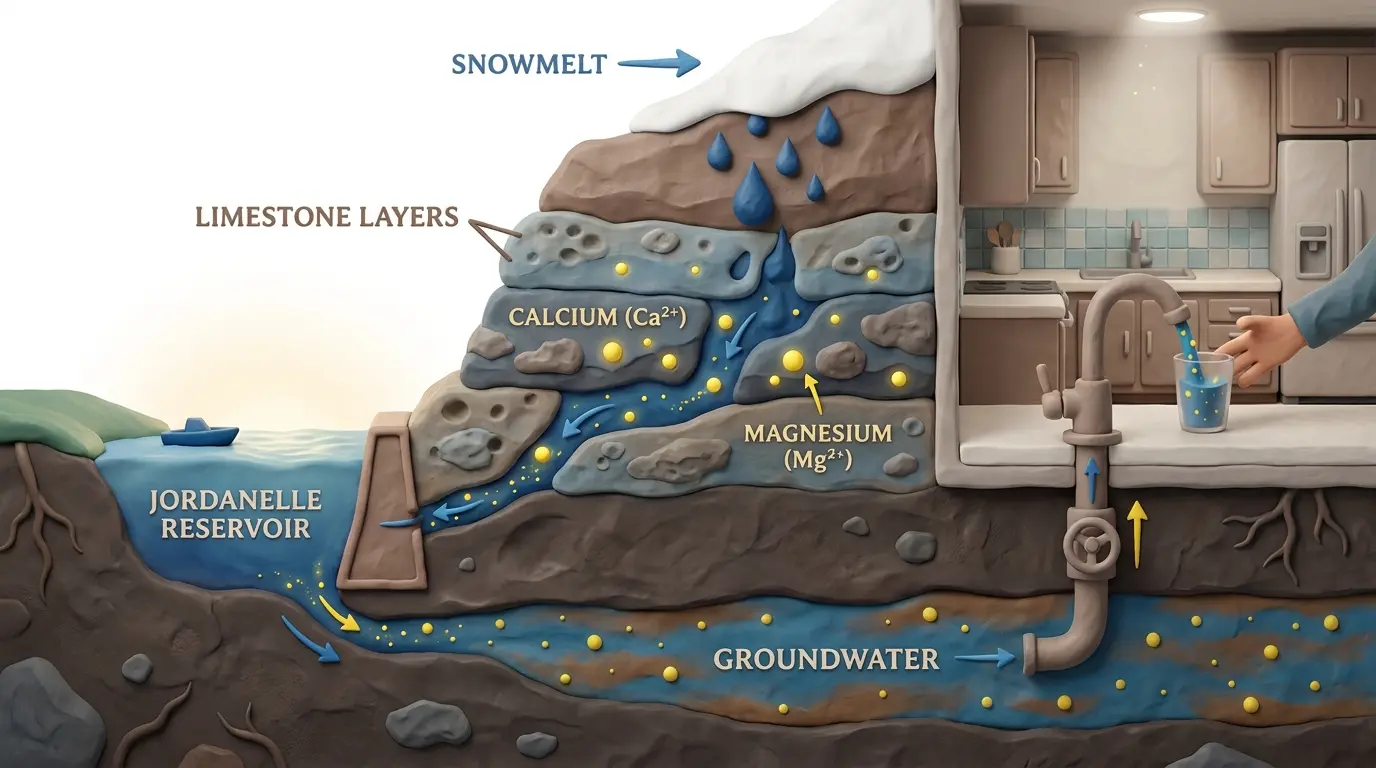
The answer lies in where Park City’s water comes from. As water travels through local rock formations before reaching your tap, it naturally picks up minerals that increase its hardness.
Where the Hard Minerals Come From
Park City’s hard water starts long before it reaches your tap. As water flows through layers of limestone and other mineral-rich rock, the specific water source naturally picks up dissolved minerals, including calcium and magnesium ions, along the way before entering the water supply.
Jordanelle Reservoir is one of the main water sources for Park City, and its water reflects the surrounding geology. Combined with local groundwater sources, this naturally mineral-rich water contributes to the high hardness levels seen throughout the area.
How Seasons Affect Water Hardness in Park City
Park City’s water hardness isn’t constant throughout the year. Mineral levels can change slightly depending on which water sources are supplying the system and how those sources are blended at different times of the year.
During the spring, snowmelt can temporarily lower mineral concentrations. In drier months, groundwater often makes up a larger share of the supply, which can increase hardness.
Environmental factors such as seasonal precipitation and drier conditions can shift that blending, and groundwater is often harder than surface water during those periods.
These seasonal shifts are a normal part of how the local water system operates. Nearby communities served by the Mountain Regional Water Special Service District experience similar patterns, reflecting the shared geology and water sources found across the region.
How Hard Water Affects Your Home
Hard water can affect pipes, fixtures, water heaters, and water-using appliances throughout the home. These effects often develop gradually as mineral deposits accumulate.
[Image: Cross-section comparison of a clean pipe versus a pipe with heavy calcium carbonate scale buildup, showing significant flow restriction]
How Hard Water Affects Your Plumbing
Hard water leaves mineral deposits inside plumbing components. Over time, this scale can restrict water flow and interfere with fixture performance. Understanding how to spot plumbing problems early can help you address these issues before they require expensive repairs.
Common effects of scale buildup include:
- Mineral deposits clogging faucet aerators and showerheads, reducing water pressure.
- Narrower pipe interiors that restrict water flow as scale accumulates.
- Uneven water pressure throughout the home as mineral buildup increases.
How Hard Water Affects Your Water Heater
Mineral deposits can settle inside a water heater tank or collect on heating components, forcing the unit to run longer to produce hot water.
This can reduce efficiency, increase operating costs, and contribute to premature wear, making maintenance important for optimal performance.
If you’re weighing water heater repair vs. replacement, consider whether untreated scale has contributed to the problem. Flushing water heaters yearly can help manage sediment and scale caused by hard water.
How Hard Water Affects Household Appliances
Hard water also takes a toll on everyday appliances. Mineral deposits can build up inside dishwashers and washing machines, reducing efficiency, extending cycle times, and increasing energy use. Knowing when to call a plumbing professional can help you address water quality issues before they lead to costly appliance repairs.
Hard Water’s Impact on Skin, Hair, and Daily Life
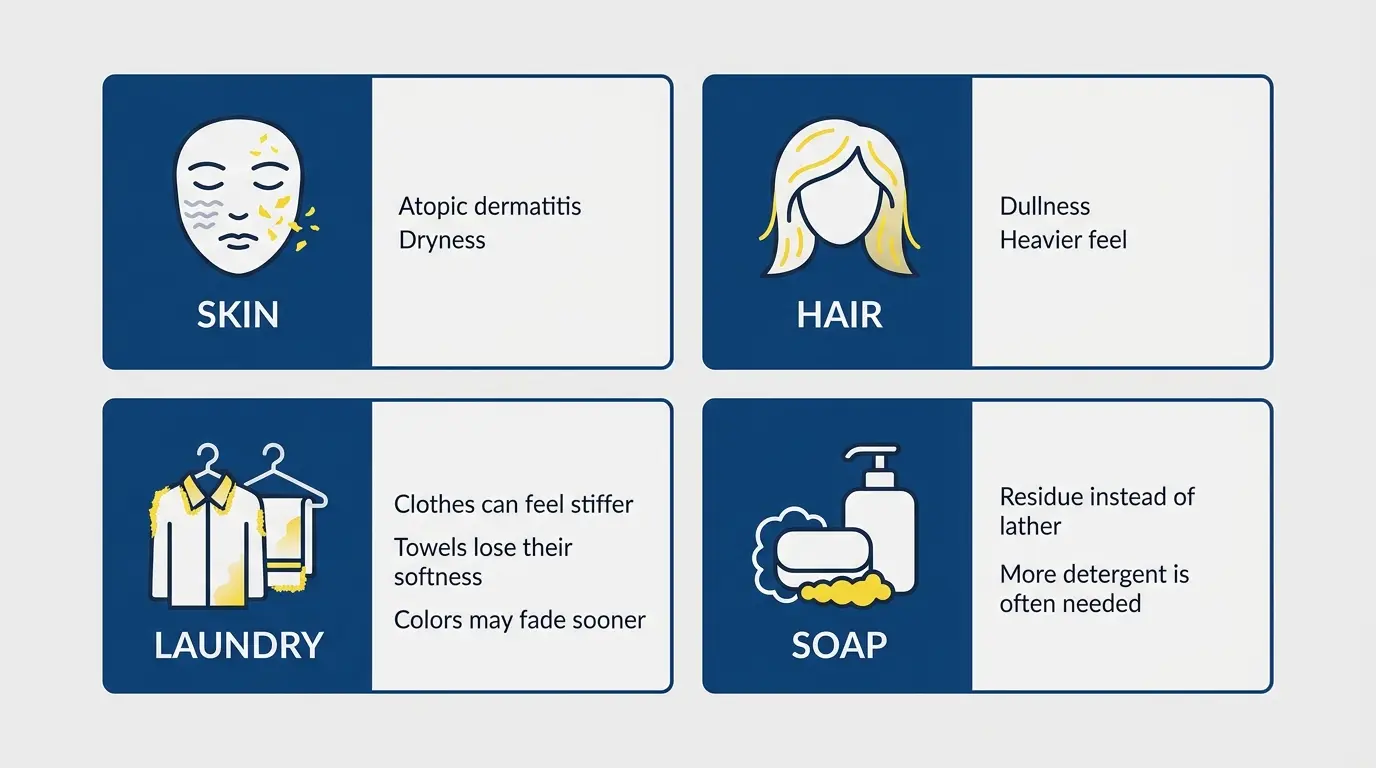
The effects of hard water extend beyond your plumbing system. It can leave its mark on your skin, hair, towels, and other everyday essentials.
How Hard Water Affects Your Skin
Hard water may also affect how your skin feels after a shower. High mineral concentrations have been linked to increased symptoms of atopic dermatitis in some people, particularly children and those with sensitive skin, and dry skin is another common complaint.
Calcium and magnesium can interfere with the skin’s natural moisture barrier, leaving it feeling dry or irritated after bathing.
Not everyone experiences these effects, but if dry or uncomfortable skin is a recurring issue, your home’s water quality may be worth considering alongside other factors. Improving your home’s water pressure management can also help create a more comfortable bathing experience.
Hair, Soap, and Laundry
Hard water changes how soap performs. Instead of producing a rich lather, calcium and magnesium react with soap to form residue, leaving skin and hair feeling less clean and often requiring more product to achieve the same results.
Hair can also be affected. Mineral deposits may build up over time, contributing to dryness, dullness, and a heavier feel. Mineral-heavy tap water can also affect the taste of water used for drinking or cooking, which is one reason some homeowners add point-of-use filtration. Some studies have suggested a possible link between prolonged hard water exposure and hair thinning, although results vary by individual.
Laundry often shows the effects as well:
- Clothes can feel stiffer after repeated washing.
- Towels lose their softness more quickly.
- Colors may fade sooner than expected.
- More detergent is often needed for the same cleaning performance.
Understanding what water softeners remove helps explain why many homeowners notice improvements in both cleaning performance and fabric care after installing a water softener.
At Beehive Plumbing, we install water softeners that help protect your plumbing system and the appliances you rely on every day. We’ll recommend a solution that’s suited to your home’s water conditions and household needs.
Schedule Your Water Assessment
What You Can Do About Hard Water in Park City
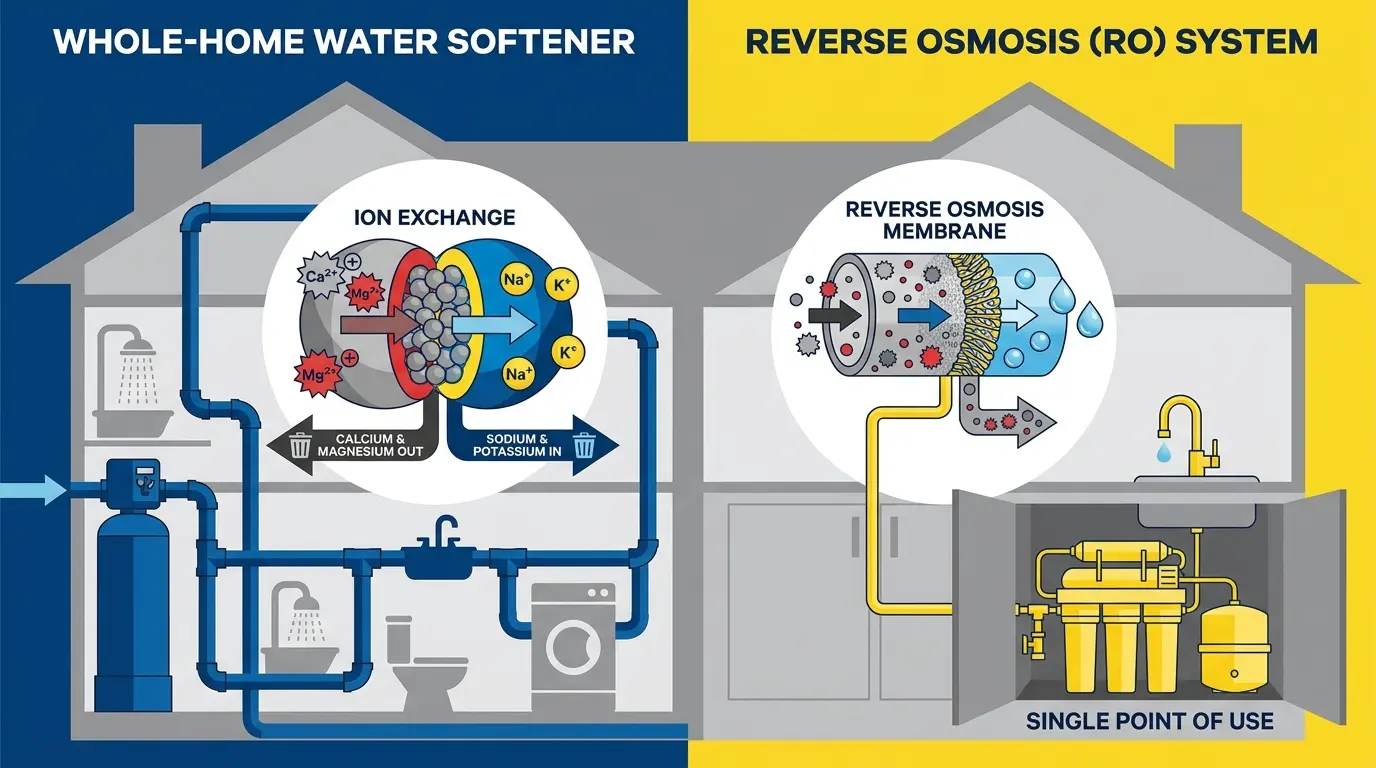
Managing hard water starts with choosing the right water treatment approach based on the conditions measured at your home and your overall water treatment needs.
Two common treatment options are common water treatment solutions that serve different purposes.
Whole-Home Water Softeners
A whole-home water softener is the most effective long-term solution for managing Park City’s hard water. Water softening systems use ion exchange to swap calcium and magnesium ions for sodium or potassium before those minerals can build up inside your plumbing system, fixtures, and water-using appliances, resulting in soft water.
Salt-based water softeners can add sodium to household water, which matters for some homeowners evaluating drinking-water options.
The right system depends on the conditions measured at your home, not a regional estimate. When choosing among water softening systems, use test data and household demand to compare the following:
- Homes in higher-hardness areas often need a system designed to handle a heavier mineral load.
- Homes with lower hardness levels may require a different capacity and regeneration schedule.
Professional sizing helps ensure the system treats your water efficiently without wasting water or salt. At Park City’s hardness levels, a properly sized water softener can help reduce scale buildup, improve appliance performance, and lower long-term maintenance needs.
Reverse Osmosis for Cleaner Drinking Water
A reverse osmosis (RO) system is one of the most effective water treatment systems for improving tap water at a single point of use, usually a dedicated kitchen tap. It uses a semipermeable membrane to reduce dissolved minerals and other contaminants, producing purified water for drinking and cooking.
An RO system is not a whole-home solution. It won’t protect your pipes, water heater, or appliances from scale buildup. Instead, it works best alongside a water softener, giving you softened water throughout the home while providing high-quality drinking water where you need it most.
Know Your Home’s Water First
Before investing in treatment, test the water at your tap to confirm the hardness level and identify any other water-quality concerns. The Environmental Protection Agency regulates over 90 contaminants in drinking water, but hardness itself is not one of them. Unregulated contaminants such as PFAS may still be present in some Park City water systems, which is why test results matter.
If you want details beyond the utility report, Beehive Plumbing can arrange professional testing for other contaminants and use that information, along with household water demand and installation requirements, to recommend appropriately sized equipment without unnecessary capacity.
Is Hard Water in Park City Safe to Drink?
Water hardness itself is not regulated as a drinking-water contaminant. For information about regulated substances and current compliance, review the Consumer Confidence Report from the utility that serves your home.
Park City Water and Mountain Regional Water publish water-quality information and Consumer Confidence Reports for different service areas, helping residents make informed decisions about water treatment needs and drinking-water quality while covering regulated substances and compliance with applicable drinking-water standards.
Does Hard Water Cause Kidney Stones?
Current research has not established a consistent link between hard water and kidney stones in the general population. Individual health risks depend on many factors, so consult a qualified healthcare professional for personal guidance.
Your Next Step as a Park City Homeowner
Hard water is common across the greater Park City area, but the exact level at your home depends on its provider and water source. Testing your water before choosing treatment helps avoid an undersized or unnecessarily large system and gives your plumbing and appliances appropriate scale protection.
At Beehive Plumbing, we provide professional service by assessing your home’s water quality before recommending tailored solutions. That helps Park City residents with staying informed before selecting equipment, and if a water softener is the right fit, we’ll help you choose a system that’s properly sized for your home and water usage.
Schedule Your Water Assessment Today
Frequently Asked Questions About Hard Water in Park City
Get quick answers to common questions about Park City’s hard water, while noting that water hardness Utah-wide varies significantly by city, including differences that matter in homes and manufacturing processes.
Does Park City have hard water?
Yes. Much of the greater Park City area has very hard water under the USGS classification. Mountain Regional Water reports a typical range of 15 to 25 GPG, but the level at your home may vary by provider and water source.
Is hard water in Park City safe to drink?
Hardness itself is not regulated as a drinking-water contaminant. Review the latest Consumer Confidence Report from your utility for information about regulated substances and current water-quality compliance.
Can hard water cause hair thinning?
Hard water can leave mineral residue that makes hair feel dry, dull, or heavy. However, current evidence does not establish hard water as a direct cause of hair loss or thinning.
Do I need a water softener in Park City?
Not every home requires a water softener, but many Park City homeowners benefit from one because of the area’s high mineral content. A professional water assessment can help identify the right water treatment solution based on local hardness, household demand, and your home’s specific water source.
How do I know if I have hard water in my area?
You can use a home test kit, review your local water quality report, or schedule professional water testing. A professional assessment provides the most accurate picture because hardness can vary between neighborhoods and individual homes, and Utah levels can differ widely by city, with salt lake city often lower than west valley city. Professional testing helps Park City residents make informed decisions about treatment based on local hardness levels and any other contaminants.